What Are the Top 10 Types of Die Casting Components?

Time:2026-09-26 Author:Oliver
0%

Die Casting Components support many products people handle every day, from vehicle housings to small appliance brackets. Their value comes from repeatable shapes, tight dimensional control, and efficient metal use. Grand View Research estimates the global die casting market reached approximately USD 87.35 billion in 2023. It also projects a 6.3% compound annual growth rate from 2024 to 2030. These figures show strong demand, but market estimates vary by research method and product definition.

A practical review of the top ten types should examine more than popularity. It should consider alloy selection, wall thickness, pressure requirements, surface finish, machining needs, and service temperature. The North American Die Casting Association provides detailed guidance on tolerances, casting design, and manufacturing quality. ISO 8062 also offers recognized dimensional and geometrical specifications for castings. Together, these references help connect market trends with real factory decisions, such as checking porosity inside an aluminum gearbox housing or measuring a magnesium electronics frame after trimming.

The ranking is not absolute. Automotive powertrain parts may lead production volume, while heat sinks or connector bodies may offer greater importance in electronics. That distinction matters. This article compares ten widely used Die Casting Components across automotive, industrial, consumer, and electrical applications. It will discuss their functions, common alloys, manufacturing advantages, and typical limitations. Some categories overlap, and that is worth admitting. A component may fit several groups depending on its geometry and end use. Careful comparison remains essential for engineers, buyers, and quality teams seeking reliable performance rather than impressive but incomplete market claims.
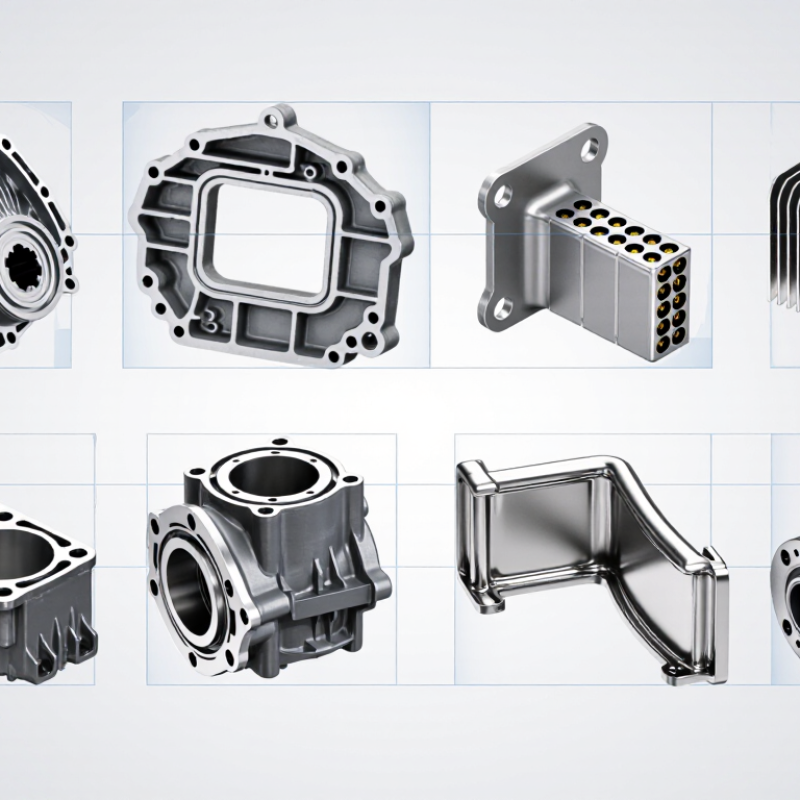
What Are the Top 10 Types of Die Casting Components?

Define the Top 10 Components by Alloy, Function, and Casting Process

Die-cast components are defined by the metal they use, the job they perform, and how molten alloy enters the die. Aluminum suits lightweight, heat-resistant parts; zinc fills fine details. Magnesium can reduce weight further. Process choice matters.

Transmission housings often use aluminum and cold-chamber high-pressure casting to combine strength with complex ribs. Motor housings use aluminum for heat transfer and dimensional stability. Pump bodies, also commonly aluminum, need pressure-tight walls and carefully controlled porosity.

Structural brackets use aluminum or magnesium, with the die designed around load paths. Heat sinks use aluminum because thin fins shed heat; fast filling helps reproduce their narrow gaps.

Appliance enclosures often use zinc for crisp edges and a smooth finish, typically through hot-chamber casting. Electrical connector bodies use zinc for detailed shapes and reliable fit. Lighting housings use aluminum to move heat away from LEDs, with cold-chamber casting supporting larger sections. Seat-frame components may use magnesium for low mass, though design validation is essential. Medical-equipment housings often use aluminum for rigid, lightweight protection.

Fit matters. Alloy selection alone does not ensure performance: wall thickness, venting, and post-casting inspection all affect the final part. Some applications need another process, and die casting is not always the best answer.

Engine Blocks and Transmission Cases: 1–4 mm Walls in NADCA Designs

Engine blocks and transmission cases rank among the most demanding die casting components. Their walls may range from 1 to 4 mm in NADCA-based designs. This thin geometry reduces weight and material use. It also challenges metal flow, filling speed, and thermal control.

An engine block needs stable cylinder support, oil passages, and accurate mounting surfaces. A transmission case adds thin ribs, bearing seats, and complex internal cavities. Designers often combine uniform wall sections with local reinforcement around bolts and shafts. However, a 1 mm wall can look efficient on paper and still produce incomplete filling or distortion. Alloy selection, die temperature, venting, and injection pressure must work together. Practical trial data matters more than a perfect-looking model.

Tips: Keep thin walls as consistent as possible. Use ribs instead of sudden thickness changes. Allow suitable draft for ejection and protect critical bores through controlled machining. Inspect castings for porosity, warpage, and dimensional drift. A design may pass an early review yet fail after repeated thermal cycling. That uncomfortable gap deserves attention. Adapting the design after testing is not weakness; it is often sound engineering.

Motor Housings and Gearboxes: High-Pressure Casting at 30,000 psi

What Are the Top 10 Types of Die Casting Components?

Motor housings and gearboxes rank among the most demanding die casting components. High-pressure die casting can drive molten aluminum into steel dies at nearly 30,000 psi. This force fills thin ribs, bearing seats, and cooling channels before the metal freezes. NADCA Product Specification Standards notes that process control strongly affects porosity, dimensional accuracy, and surface finish. Pressure helps, but it cannot repair poor venting.

A motor housing needs a rigid shell with precise mounting points. A gearbox case must also protect gears, hold lubricant, and maintain shaft alignment. In production reviews, even a 0.1 mm shift can create sealing problems or unwanted noise. Industry data supports growing demand for lightweight cast structures. The International Energy Agency reported more than 14 million electric cars sold globally in 2023, representing about 18% of new car sales. More electric vehicles mean more cast housings and thermal-management parts.

The 2023 North American Light Vehicle Aluminum Content Study projected average aluminum use could reach about 514 pounds per vehicle by 2030. That trend favors integrated castings with fewer fasteners. Still, larger parts bring difficult compromises. Thin walls may fill quickly but trap gas. Stronger ribs can increase weight and slow solidification. Some castings still warp after ejection. That uncomfortable detail deserves attention. Engineers should validate gating, vacuum assistance, heat treatment, and leak testing together, not separately.

Motor Housings and Gearboxes: 30,000 psi Pressure Conversion

The chart shows equivalent expressions of a 30,000 psi reference pressure: approximately 206.8 MPa, 2,068 bar, and 2,109 kgf/cm². Because each bar uses a different unit, its length is not a direct comparison of pressure; the horizontal axis is logarithmic. Actual die-casting pressures vary by machine, alloy, and process.

Brackets, Covers, Heat Sinks, and Valve Bodies: 0.5–3 mm Walls

In die casting, component choice often begins with wall thickness. Brackets, covers, heat sinks, and valve bodies commonly use 0.5–3 mm walls. This range saves weight, but it leaves little room for filling errors. A 0.5 mm cover may need carefully placed gates and vents. A 3 mm valve body offers more thermal mass and strength, yet thicker zones can trap porosity. Experienced engineers inspect flow simulation, section thickness, and ejection loads before approving a tool.

Brackets Brackets need ribs around bolt holes, not simply thicker walls.
Covers Covers benefit from uniform sections and controlled draft, especially around sealing edges.
Heat sinks Heat sinks require thin fins, consistent spacing, and strong metal flow to preserve sharp profiles.
Valve bodies Valve bodies demand stable internal passages, pressure-tight surfaces, and machining allowance.

Aluminum alloys are common, while zinc can support finer details at lower section thicknesses. Magnesium may reduce mass, but design reviews must examine stiffness and corrosion protection. Real production often exposes assumptions. A visually perfect sample may still fail leak testing.

Tips: Keep nominal walls close to the target thickness. Use ribs instead of heavy pads. Add draft where ejection requires it. Check vents near last-fill areas. Measure porosity through sectioning or imaging, not appearance alone. I would also prototype the thinnest feature early. A 0.5 mm wall may work in one geometry and fail in another.

Connectors and Structural Parts: Compare Porosity, Tolerance, and Strength

Die-cast components range from connector shells and sensor housings to brackets, covers, frames, and heat sinks. Their design priorities differ. A connector may need precise mating faces and stable alignment, while a structural part must carry loads through ribs, bosses, and mounting points. Small details matter.

Porosity is a concern in both groups, but its consequences vary. Voids near a connector’s sealing surface can cause leaks or weaken a thin wall. In a bracket, pores around a bolt boss may reduce fatigue life under repeated vibration. Process control helps, yet no casting is perfectly uniform. Critical regions may need sectioning, X-ray inspection, or pressure testing, depending on the application.

Tolerance also deserves careful planning. Connector interfaces often need machined datums to control fit; relying on every as-cast surface can be unrealistic. Structural parts may allow wider variation away from mounting faces, but load paths still need sound geometry. Choose strength based on the alloy, wall thickness, and expected forces—not a material data sheet alone. Sharp corners and abrupt thickness changes can invite defects. Not always easy to avoid. A practical design balances casting flow, machining access, inspection, and the part’s real service conditions.

What Are the Top 10 Types of Die Casting Components? — Connectors and Structural Parts: Compare Porosity, Tolerance, and Strength

This comparison covers common aluminum and zinc die-cast component families. Porosity and strength ratings are relative: actual results depend on alloy, casting process, part geometry, gating and venting, and inspection requirements.

# Component Type Typical Applications Porosity Risk Indicative Tolerance on Controlled Dimensions Relative Strength Potential Design and Quality Considerations
1 Electrical Connector Housings Automotive, industrial, and appliance electrical connections Moderate About ±0.05–0.15 mm for selected small, controlled features; sealing faces may need machining Low to medium Thin walls and small cavities require consistent filling. Connector alignment and sealing features often matter more than bulk load capacity.
2 Sensor and Electronics Enclosures Sensor bodies, instrument cases, and electronic equipment housings Moderate About ±0.08–0.20 mm on selected features; tighter fits may require secondary machining Low to medium Thin sections, bosses, and enclosed cavities can trap gas. Wall uniformity and correctly designed vents help improve consistency.
3 Automotive Brackets and Mounts Engine, suspension, seat, and accessory mounting points Moderate About ±0.10–0.25 mm on selected cast features; mounting bores are commonly machined when precision is critical Medium to high Ribs and generous fillets can improve stiffness. Fatigue performance depends on load direction, alloy, and defect control.
4 Gearbox and Transmission Housings Gear enclosures, transmission cases, and drive-system housings Moderate to high About ±0.10–0.30 mm on selected cast dimensions; bearing seats and alignment features are often machined Medium to high Complex geometry and thick-to-thin transitions can raise porosity risk. Bearing alignment and oil sealing commonly require finish machining.
5 Electric Motor Housings Motor bodies, end covers, and drive-unit enclosures Moderate About ±0.10–0.30 mm on selected cast features; bore and concentricity requirements may call for machining Medium to high Housing stiffness and dimensional stability support rotor and stator alignment. Cooling features and uniform wall sections aid performance.
6 Pump and Valve Bodies Fluid-handling equipment, hydraulic systems, and control valves Moderate to high About ±0.10–0.30 mm on selected cast dimensions; ports and sealing surfaces may need machining Medium to high Pressure-tightness is sensitive to connected porosity. Casting process selection, pressure testing, and machining allowance should be considered early.
7 Heat Sinks and Thermal Enclosures Power electronics, LED equipment, and industrial control systems Low to moderate About ±0.10–0.30 mm on selected features; fin spacing and flatness depend on size and tooling Low to medium Thin fins need reliable metal flow. Thermal performance depends on alloy, surface area, and contact-face flatness as well as casting quality.
8 Chassis and Cross-Member Parts Vehicle frames, underbody structures, and load-bearing assemblies Moderate to high About ±0.20–0.50 mm on selected large cast dimensions; datum and joint features may require machining High, when properly engineered Large, thin-walled geometries can be sensitive to filling and distortion. Structural performance requires validation for load paths and fatigue.
9 Large Structural Nodes and Integrated Castings Vehicle body nodes, suspension structures, and multi-function structural parts Moderate to high About ±0.20–0.50 mm on selected large features; tighter interfaces generally need controlled machining High, subject to design and validation Large castings combine several load paths and section thicknesses. Process simulation, inspection planning, and fatigue testing are important.
10 Appliance and Industrial Equipment Frames Equipment supports, housings, and rigid mounting frames Low to moderate About ±0.15–0.40 mm on selected dimensions, depending on overall size and feature location Medium Ribs and well-supported mounting points can provide stiffness without excessive mass. Larger spans may need attention to flatness and distortion.

How to interpret the tolerance figures: These are indicative planning ranges for selected controlled dimensions, not guaranteed tolerances for an entire part. Achievable tolerances depend on material, part size, geometry, tooling, process capability, and whether features are measured as-cast or after machining. Porosity ratings describe relative risk, not a measured defect rate.

FAQS

How are die-cast components classified?

They are classified by alloy, function, and casting process. Material choice affects weight, strength, detail, and heat management.

Why is aluminum common for transmission housings?

Aluminum combines low weight with useful strength. Cold-chamber casting can form ribs, mounting areas, and complex cavities.

What makes engine blocks difficult to cast?

Thin walls, oil passages, cylinder supports, and mounting surfaces demand controlled metal flow. A 1 mm wall may not fill completely.

How can designers improve thin-wall casting?

Keep wall thickness consistent. Use ribs instead of abrupt thickness changes. Control die temperature, venting, and injection pressure.

Why is zinc suitable for appliance enclosures?

Zinc reproduces crisp edges and detailed shapes. Hot-chamber casting often supports smooth, compact enclosure designs.

When is magnesium useful?

Magnesium can reduce component weight further. It may suit structural brackets or seat-frame parts, but testing remains essential.

Why do heat sinks usually use aluminum?

Aluminum transfers heat effectively. Thin fins can release heat through narrow gaps when filling speed is properly controlled.

What inspections should follow casting?

Inspect for porosity, warpage, and dimensional drift. Check critical bores and mounting surfaces after machining.

Is die casting always the best process?

No. Some shapes need another process. Alloy choice alone cannot guarantee performance.

Can a successful design still fail later?

Yes. Thermal cycling may reveal distortion or weak areas. Computer models help, but practical trial data can disagree. That matters.

Conclusion

Die Casting Components are essential in automotive, electrical, industrial, and mechanical systems because they combine lightweight design, dimensional accuracy, and efficient production. The top ten types include engine blocks, transmission cases, motor housings, gearboxes, mounting brackets, protective covers, heat sinks, valve bodies, electrical connectors, and structural parts. Their performance depends on the selected alloy, functional requirements, wall thickness, and casting method. Engine blocks and transmission cases commonly use durable aluminum or magnesium alloys with 1–4 mm walls, following design principles that support strength and consistent filling.

Motor housings and gearboxes are often produced through high-pressure die casting, with pressures reaching approximately 30,000 psi to achieve detailed shapes and reliable surfaces. Brackets, covers, heat sinks, and valve bodies may feature walls from 0.5–3 mm, depending on load, thermal control, and fluid-flow needs. For connectors and structural parts, manufacturers must balance porosity, dimensional tolerance, fatigue strength, and corrosion resistance. Together, these considerations determine the most suitable alloy and casting process for each application.


Oliver

Oliver

Oliver is a seasoned marketing professional with a wealth of expertise in driving brand awareness and engagement. With a deep understanding of our company's product offerings, he consistently delivers high-quality content that enriches our professional blog. His insights not only shed light on......