Casting Components sit at the intersection of design, metallurgy, production control, and global supply risk. The World Foundry Organization’s latest global census reports annual casting production above 100 million tonnes, confirming the sector’s enormous industrial scale. Yet volume does not guarantee dependable quality. A small shrinkage cavity inside a pump body can cause leakage, downtime, and expensive field repairs.
This guide, “Top 10 Types of Casting Components for Global Buyers,” examines the components most often specified across automotive, energy, construction, agricultural, and industrial equipment markets. It considers material selection, casting process, dimensional tolerance, surface finish, machining allowance, and inspection requirements. The IEA’s Global EV Outlook 2024 recorded nearly 14 million electric-car sales in 2023. That shift increases demand for lightweight aluminum housings, motor covers, battery structures, and thermal-management parts. Meanwhile, the U.S. Geological Survey’s Mineral Commodity Summaries 2024 highlights the strategic importance of aluminum, iron, steel, and other metals used throughout foundry supply chains.
Practical sourcing requires more than comparing unit prices. Buyers should review ISO 9001 systems, IATF 16949 capability where applicable, material certificates, process-control plans, and traceable inspection records. Standards such as ASTM, EN, and ISO can clarify acceptance criteria, but they do not replace a capable supplier audit. No ranking is perfect. Component suitability depends on geometry, load, production volume, alloy availability, and the buyer’s target market. Some suppliers may offer attractive prototypes but struggle with stable mass production. Others may deliver excellent castings while lacking responsive engineering support. These differences deserve careful attention before purchase orders are released.
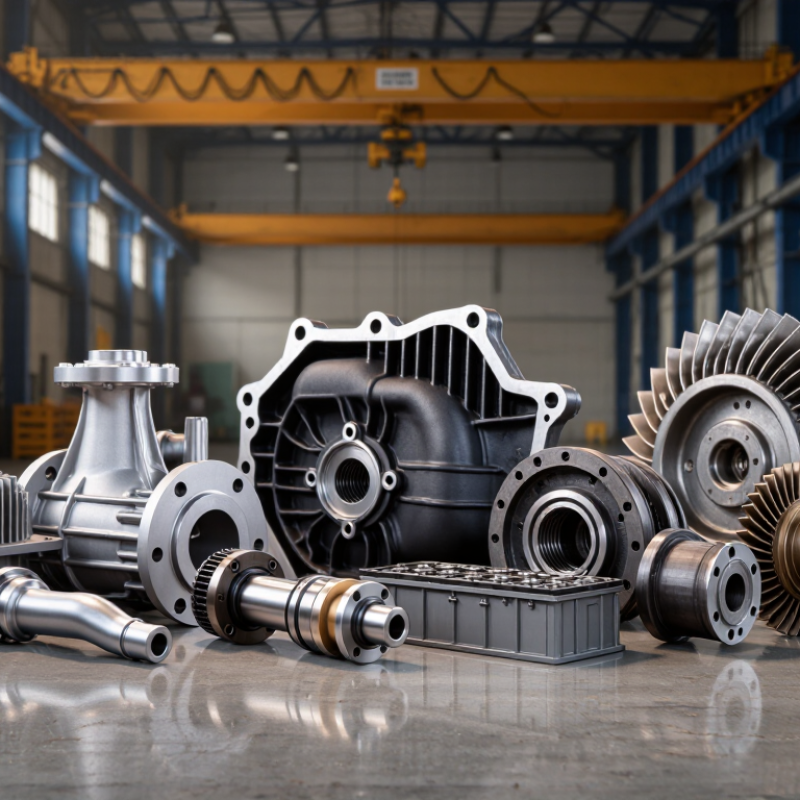
Casting components are defined by both process and function. The World Foundry Organization’s 2023 census reported global casting production above 100 million tonnes in 2022. That scale reflects demand across vehicles, pumps, construction equipment, and industrial machinery. Yet production volume does not prove suitability. A neat ten-part chart can mislead.
Sand casting suits large housings and low-volume parts. Shell molding improves surface detail with resin-coated sand. Investment casting creates complex, thin-walled components with tight geometry. Die casting supports high-volume aluminum or zinc parts with consistent dimensions. Permanent-mold casting offers stronger surfaces for repeated production. Centrifugal casting forms pipes, sleeves, and rings through rotational force. Continuous casting produces long billets and slabs for later processing. Lost-foam casting copies delicate internal shapes without traditional cores. Plaster casting works well for smaller, detailed nonferrous components. Squeeze casting combines pressure and solidification for dense structural parts.
The U.S. Department of Energy’s Metal Casting Industry Energy and Environmental Profile identifies melting as a major energy-consuming stage. Buyers should therefore review alloy chemistry, furnace controls, porosity data, and heat-treatment records. ISO 8062 provides a useful framework for casting dimensional tolerances and machining allowances. In practice, drawings often omit realistic draft angles or parting-line limits. That oversight creates avoidable cost. A reliable supplier comparison checks process capability, inspection methods, sample reports, and traceability before comparing unit prices.
Top 10 Types of Casting Components for Global Buyers
Sand, Die, Investment, and Centrifugal Casting in 2022’s 109 Mt Output
The World Foundry Organization’s 2023 Census recorded about 109.7 million tonnes of global castings in 2022. That figure covers ferrous and non-ferrous production across major markets. Sand casting likely carried the largest share, especially for engine blocks, pump bodies, valve housings, and structural frames. Its tooling cost remains practical for large, heavy components. Surface finish can be rougher, though machining often corrects it.
Die casting serves high-volume aluminium and zinc components. Common examples include motor housings, brackets, covers, and electronic enclosures. Investment casting supports smaller, complex parts with thin sections, such as impellers, medical instruments, and aerospace fittings. Centrifugal casting is well suited to pipes, bushings, sleeves, and rings. Rotation helps distribute metal against the mould wall.
The American Foundry Society reports that casting remains essential to transportation, energy, construction, and industrial equipment supply chains. However, buyers should not treat the 109.7 Mt figure as a direct process comparison. Public census data does not always separate sand, die, investment, and centrifugal volumes consistently. That limitation matters. A low-cost casting can become expensive after machining, inspection, scrap, and freight. In practice, I would compare geometry, annual volume, alloy, tolerances, and defect risk before choosing a process. My own caution is simple: the cheapest mould is rarely the cheapest complete component.
Sand, die, investment, and centrifugal casting in the context of approximately 109 million tonnes of global casting output in 2022.
The chart presents a rounded industry-level estimate of 2022 global casting output by major component family. Automotive powertrain parts and industrial housings account for a substantial share, while investment-cast aerospace, medical, and precision components represent lower-volume but higher-value applications. Values are shown in million tonnes and sum to approximately 109 Mt.
Material selection often determines whether a casting survives heat, vibration, or corrosion. The World Foundry Organization reported global metal casting production at more than 109 million metric tons in 2022. Ferrous alloys still dominate many heavy-duty components because steel and iron offer strength, wear resistance, and competitive cost.
Cast steel suits valve bodies, structural brackets, and high-load machinery parts. It handles impact better than many aluminum grades, but it usually requires more machining and corrosion protection.
Gray iron dampens vibration effectively, making it practical for machine bases, housings, and brake components. Ductile iron adds better tensile strength and toughness. It can still fail when designers ignore section changes or internal defects.
Nonferrous alloys reduce weight and improve conductivity. The International Aluminium Institute reported global primary aluminum production above 70 million tonnes in 2023. Aluminum castings work well for pump housings, vehicle cases, and heat-management parts, especially where every kilogram matters. Copper alloys remain valuable for electrical connectors, impellers, and corrosion-sensitive fittings. Their thermal and electrical conductivity is excellent, but material cost and density need careful review.
There is no universal winner. Not even close.
A buyer should compare alloy chemistry, casting method, wall thickness, heat treatment, inspection records, and regional standards. The International Copper Study Group reported refined copper production near 27 million tonnes in 2023, yet supply conditions can change quickly. A small design mistake, such as a sharp internal corner, may outweigh a sophisticated material choice. Specification review should happen before tooling begins.
Top 10 Types of Casting Components for Global Buyers
Casting tolerances directly affect fit, sealing, machining cost, and inspection time. For investment-cast impellers, brackets, medical housings, and small valve parts, buyers often specify ±0.1 to ±0.3 mm. This range requires stable wax patterns, controlled shell thickness, and careful datum selection. It is achievable, but not automatically guaranteed across every surface.
Die-cast covers, sensor bodies, gear cases, and connector housings commonly hold ±0.1 to ±0.5 mm. Permanent-mold casting usually provides ±0.3 to ±0.8 mm for pump bodies, pulleys, and structural frames. Centrifugal casting may reach ±0.5 to ±1.5 mm, depending on diameter and wall thickness. Sand-cast engine blocks, pipe fittings, machine bases, and housings often require ±1 to ±3 mm. Large castings need wider allowances.
Reality is less tidy.
These figures change with alloy, casting size, draft angle, and measurement location. A thin aluminum housing may distort after cooling. A heavy iron base may shift slightly during shakeout. Buyers should define critical dimensions separately from nonfunctional surfaces. Include machining allowances, datum references, flatness, and inspection equipment in the drawing. I have seen suppliers accept ±0.1 mm broadly, then discover that the tooling and process cannot support it economically. A practical specification links each tolerance to the casting method and the part’s actual function.
Top 10 Types of Casting Components for Global Buyers
Global buyers often source housings, brackets, covers, manifolds, pump bodies, valve bodies, impellers, flanges, pulleys, and frames. Each component needs documented control, not only attractive samples. The ISO Survey 2022 recorded 1,265,216 ISO 9001 certificates worldwide. This figure shows quality systems are common, but certificates alone cannot guarantee stable casting performance.
IATF 16949 adds stricter controls for automotive components, including traceability, process risk analysis, and corrective action. ASTM and EN requirements define chemistry, mechanical properties, dimensions, and testing methods. RoHS compliance also requires controlled material declarations for restricted substances. The 2023 World Casting Census placed annual global casting production above 100 million tonnes. At this scale, small specification errors can spread across thousands of parts. A certificate is not proof of perfect components. Our audits still find incomplete heat records and unclear revision control.
Tips: Request the exact standard edition, inspection plan, material certificate, and RoHS declaration. Confirm whether ASTM or EN testing applies to the final casting or the raw alloy. Ask for sample traceability from furnace charge to packing label. Keep one approved drawing revision. Mixed revisions create expensive confusion. Use dimensional reports, hardness results, and radiographic records when risk justifies them. Supplier experience matters, yet independent verification remains necessary. Even mature systems can fail when production pressure replaces disciplined review.
| No. | Casting Component Type | Common Applications | Typical Casting Processes | Common Material Families | Relevant ASTM References | Relevant EN References | ISO 9001 | IATF 16949 | RoHS Considerations | Key Buyer Inspection Points |
|---|---|---|---|---|---|---|---|---|---|---|
| 1 | Engine and Transmission Housings | Automotive powertrain, agricultural machinery, industrial drive systems, and electric motor enclosures. | High-pressure die casting, low-pressure casting, gravity die casting, and sand casting for large sections. | Aluminum-silicon alloys; selected magnesium alloys; cast iron for heavy-duty housings. | ASTM B85/B85MASTM A48/A48M | EN 1706EN 1561 | Applicable | Required for automotive supply chains when specified by the customer | Aluminum and magnesium alloys may be subject to restricted-substance declarations; verify coatings, lubricants, and plating separately. | Leak tightness, porosity, dimensional stability, mounting-hole position, wall thickness, pressure testing, and X-ray or CT inspection where specified. |
| 2 | Valve Bodies and Actuator Housings | Water, gas, hydraulic, pneumatic, process-control, and industrial fluid-handling equipment. | Sand casting, investment casting, centrifugal casting for selected parts, and precision machining after casting. | Ductile iron, gray iron, carbon steel, stainless steel, bronze, and aluminum alloys. | ASTM A216/A216MASTM A351/A351MASTM A536 | EN 10213EN 1563EN 1982 | Applicable | Applicable when used in automotive production or required by the purchasing specification | Confirm alloy composition and ensure surface treatments do not introduce restricted substances above applicable limits. | Pressure and leakage tests, material certificates, casting integrity, flange dimensions, thread accuracy, and corrosion-resistant surface condition. |
| 3 | Pump Casings and Impellers | Water pumps, chemical pumps, process pumps, HVAC equipment, and industrial circulation systems. | Sand casting, investment casting, lost-foam casting, centrifugal casting, and precision machining. | Cast iron, ductile iron, stainless steel, nickel-aluminum bronze, and aluminum alloys. | ASTM A48/A48MASTM A743/A743MASTM B148 | EN 1561EN 1563EN 10283EN 1982 | Applicable | Required when supplied to automotive or mobility-related production programs | Check alloy, coatings, elastomer interfaces, and any electrical or electronic subassembly for RoHS relevance. | Hydrostatic testing, balance, concentricity, surface roughness, dimensional inspection, corrosion resistance, and internal defect control. |
| 4 | Manifolds and Fluid Distribution Blocks | Hydraulic power units, pneumatic systems, fuel systems, refrigeration, and industrial automation. | Sand casting, gravity die casting, high-pressure die casting, and investment casting for complex passages. | Aluminum alloys, ductile iron, stainless steel, brass, and bronze. | ASTM B26/B26MASTM B85/B85MASTM B584 | EN 1706EN 1982EN 1563 | Applicable | Applicable according to the automotive customer and production scope | Part material is generally outside RoHS scope unless incorporated into applicable electrical or electronic equipment; verify the finished assembly. | Internal passage cleanliness, pressure decay, port alignment, thread quality, dimensional tolerances, and burr removal. |
| 5 | Automotive and Industrial Brackets | Suspension supports, motor mounts, structural supports, seat brackets, and equipment mounting systems. | High-pressure die casting, gravity die casting, sand casting, and investment casting. | Aluminum alloys, magnesium alloys, ductile iron, and steel castings. | ASTM B85/B85MASTM A536ASTM A27/A27M | EN 1706EN 1563EN 10293 | Applicable | Normally required for automotive series-production suppliers | Evaluate paint, conversion coating, plating, and any attached electrical components for restricted substances. | Load-bearing performance, fatigue resistance, datum control, hole location, deformation, weldability where applicable, and crack inspection. |
| 6 | Gearbox Covers and End Covers | Reducers, industrial gearboxes, electric motors, pumps, compressors, and agricultural equipment. | High-pressure die casting, gravity die casting, sand casting, and low-pressure casting. | Aluminum-silicon alloys, zinc alloys for small parts, and cast iron for heavy-duty covers. | ASTM B85/B85MASTM B86ASTM A48/A48M | EN 1706EN 12844EN 1561 | Applicable | Applicable where the component is part of an automotive production program | Confirm the material, protective finish, and any electrical interface against the applicable restricted-substance requirements. | Flatness, sealing-groove dimensions, bearing-seat position, porosity, pressure or oil-leak testing, and machining capability. |
| 7 | Pipe Fittings and Flanged Connectors | Water treatment, plumbing, fire protection, process piping, compressed air, and industrial utilities. | Sand casting, investment casting, centrifugal casting, and die casting for smaller non-ferrous fittings. | Ductile iron, malleable iron, carbon steel, stainless steel, brass, and bronze. | ASTM A395/A395MASTM A536ASTM A351/A351MASTM B584 | EN 545EN 10242EN 10283EN 1982 | Applicable | Usually not required unless supplied into an automotive quality-management scope | Lead and other restricted substances require special attention for brass, bronze, coatings, and products used in regulated equipment. | Pressure rating, dimensional conformity, wall thickness, thread or flange accuracy, coating adhesion, corrosion protection, and leakage testing. |
| 8 | Brake Calipers and Brake Components | Passenger vehicles, commercial vehicles, motorcycles, and specialized mobile equipment. | Gravity die casting, low-pressure casting, sand casting, and precision machining. | Aluminum alloys, ductile iron, gray iron, and selected steel castings. | ASTM B26/B26MASTM A48/A48MASTM A536 | EN 1706EN 1561EN 1563 | Applicable | Commonly required for automotive production and safety-related supply chains | Review aluminum, iron, coatings, lubricants, and attached sensor or electronic materials for applicable restrictions. | Mechanical strength, dimensional accuracy, pressure integrity, fatigue performance, corrosion resistance, and traceability of safety-critical batches. |
| 9 | Flywheels, Rotors, and Balance Components | Engines, generators, electric motors, compressors, agricultural machinery, and rotating industrial equipment. | Sand casting, permanent-mold casting, centrifugal casting, and investment casting for smaller precision parts. | Gray iron, ductile iron, cast steel, and aluminum alloys. | ASTM A48/A48MASTM A536ASTM A27/A27M | EN 1561EN 1563EN 10293 | Applicable | Required when used in automotive or other IATF-certified production chains | RoHS normally applies to the finished electrical or electronic equipment rather than to a standalone mechanical casting; verify customer scope. | Dynamic balance, crack detection, fatigue resistance, runout, concentricity, material hardness, and dimensional inspection. |
| 10 | Heat Sinks and Thermal Management Castings | Power electronics, LED systems, industrial controls, battery systems, telecommunications equipment, and motor drives. | High-pressure die casting, gravity die casting, sand casting, and specialized aluminum casting processes. | Aluminum-silicon alloys, commercially pure aluminum, and selected copper alloys. | ASTM B26/B26MASTM B85/B85MASTM B275 | EN 1706EN 573-3EN 755-2 | Applicable | Applicable when supplied to automotive electronics or vehicle electrical systems | Typically relevant when incorporated into electrical or electronic equipment placed on applicable markets | Thermal conductivity, fin geometry, flatness, surface treatment, contact resistance, porosity, mounting-hole accuracy, and RoHS material declarations. |
Global casting output reached about 109.7 million tonnes in 2022. The figure includes ferrous and non-ferrous castings. Public data does not always separate each casting process clearly. That makes direct process comparisons imperfect.
Sand casting suits large, heavy parts with moderate production volumes. Common examples include engine blocks, pump bodies, valve housings, and structural frames. Tooling costs are usually practical. Surfaces may feel rough before machining.
Die casting suits high-volume aluminium or zinc components. Typical parts include motor housings, brackets, covers, and electronic enclosures. It supports repeatable shapes and efficient production. It becomes less attractive for low-volume work.
Investment casting fits smaller parts with complex shapes and thin sections. Examples include impellers, medical instruments, and precision fittings. It can reduce machining on intricate surfaces. The process may cost more.
Centrifugal casting suits pipes, bushings, sleeves, and rings. Rotation pushes molten metal against the mould wall. This can support dense, cylindrical components. It is not ideal for every geometry.
Choose steel for impact and high-load applications. Use grey iron when vibration damping matters. Ductile iron offers better toughness than grey iron. Aluminium reduces weight and supports heat management. Copper alloys provide strong electrical and thermal conductivity. There is no universal winner.
Request the exact material specification and drawing revision. Review the inspection plan, dimensional report, and material certificate. Ask for furnace-to-packing traceability. Hardness, mechanical, or radiographic testing may be necessary. Certificates help, but they do not prove perfect parts. That part is easy to forget.
Compare tooling, machining, inspection, scrap, packaging, and freight together. A cheap mould may create expensive finishing work. Review wall thickness, section changes, alloy, and tolerances early. Avoid sharp internal corners when possible. My own caution: the lowest quotation is often incomplete.
Casting Components are essential industrial parts produced through different manufacturing processes, each suited to specific shapes, sizes, performance needs, and production volumes. This overview explains ten major types according to process and function, including sand, die, investment, and centrifugal casting. Together, these methods support a wide range of applications and contribute to the large-scale global casting industry. The article also compares ferrous and nonferrous alloys, highlighting the practical differences among steel, iron, aluminum, and copper in terms of strength, weight, corrosion resistance, and machinability.
For global buyers, selecting the right casting method requires careful attention to dimensional accuracy and functional requirements. Typical tolerances may range from approximately ±0.1 mm for precision processes to ±3 mm for less precise methods. Quality and market access also depend on compliance with recognized requirements, including ISO 9001, IATF 16949, ASTM, EN, and RoHS. By evaluating process capability, alloy performance, tolerances, and documentation, buyers can make more reliable sourcing decisions.

Haochu Machinery